
OEM, ODM and private label describe different aspects of bringing a branded product to market. In a typical sourcing discussion, OEM centers on production to a buyer’s requirements, while ODM involves a supplier-developed design. Private label describes selling a third-party-made product under your brand. These arrangements can overlap.
For a car care accessories buyer, the useful question is what the supplier will develop, manufacture, customize and approve with you. A shared definition prevents a quotation for a branded stock towel from being mistaken for a fully developed exclusive product.
This guide explains the options and the information needed to move from an idea to a reviewable order.
What Do OEM, ODM and Private Label Mean?
OEM: Start With the Buyer’s Requirements
OEM stands for original equipment manufacturer. In this guide, an OEM arrangement means the supplier produces against buyer-led specifications. Those requirements might describe a towel’s dimensions and edge finish, or a brush’s shape, materials and packaging.
The level of development can vary. A request to adjust an existing product is different from a new design requiring tooling. Define the actual work rather than assuming the term includes every customization service.
ODM: Start With a Supplier-Developed Design
ODM stands for original design manufacturer. The supplier contributes the underlying product design, which the buyer may select or adapt within an agreed scope.
Ask which elements already exist, which require development and which can change. A catalog illustration is not enough to establish who developed the design or what rights accompany the purchase.
Private Label: Define the Branding Arrangement
A private label product is made by another business and sold under your brand.
Private label does not, by itself, specify how much product development is included. A branded towel selected from an existing range and a towel produced to your detailed requirements could both be sold under your label. Exclusivity and design rights need separate written clarification.
Compare the Options by Responsibility
Supplier terminology varies. Use this table to frame a conversation, then document the arrangement for your project.
| Discussion point | OEM arrangement | ODM arrangement | Private label arrangement |
|---|---|---|---|
| Main starting point | Buyer-led specification | Supplier-developed design | Product sold under buyer’s brand |
| Design input to clarify | What the buyer supplies and supplier adapts | What exists and what can change | Whether branding alone or product changes are included |
| Useful buyer input | Drawings, dimensions, materials and intended use | Target use, preferred concept and requested changes | Brand assets, packaging and product selection |
| Approval focus | Conformity to the agreed specification | Approved design and agreed adaptations | Product, artwork and packing accuracy |
| Essential question | What development work is included? | What design and tooling access is included? | What makes this range distinct, if anything? |
None of these terms guarantees a particular minimum order quantity, price or lead time. Those depend on the product, requested changes, production arrangement and packaging.
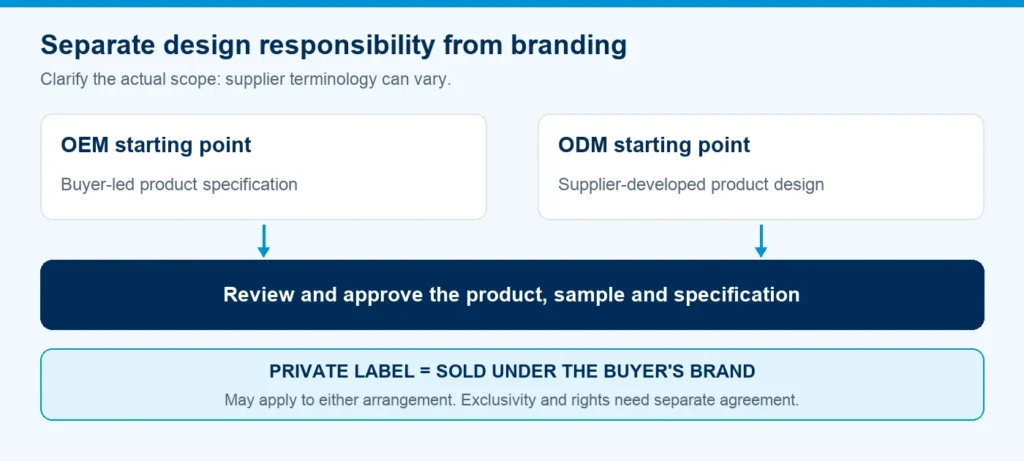
Design responsibility and branding are connected decisions, but they are not the same decision.
Choose a Route for the Product You Need
Imagine a distributor introducing a small car care range. Selecting existing towel constructions and adding approved sleeves could be a practical starting point. It allows the team to concentrate on product selection, packaging and customer feedback before commissioning new designs.
Now imagine a brand with a detailed brush concept and defined dimensional requirements. That project needs a discussion about development, feasibility, samples and any tooling. A basic logo quotation would leave important work unspecified.
These are illustrative scenarios, not promises about a particular supplier’s capabilities. Ask suppliers to identify what they can deliver directly and what involves another production partner. Begin with the customer problem, then choose the sourcing arrangement that can meet it.
Prepare a Product Brief That Supports a Useful Quotation
A brief should let two suppliers quote the same intended product. Include enough detail to reveal differences without pretending every unresolved choice is already decided.
Explain the Customer and Application
State whether the product is for professional detailers, retail car owners, distributors or a promotional kit. Describe the task and intended surfaces. “Glass cloth for a retail cleaning kit” is more useful than “high-quality microfiber.”
Identify your target sales market and sales channel. Ask which product and packaging information the supplier can provide for your review. Avoid printing certification marks or performance claims without appropriate supporting evidence and permission.
Separate Fixed Requirements From Preferences
List the dimensions, materials, colors and features that must be maintained. Mark other choices as open for recommendation. For towels, include construction, composition, edge treatment and care information; the guide to choosing microfiber towels for car detailing explains those comparisons.
Give references carefully. Explain which feature a reference illustrates rather than asking the supplier to copy an entire competing product.
Describe the Packaging and Quantity
Specify the proposed pack count, sleeve or box format, kit contents and any barcode requirements. Supply approved brand files and identify who checks text, translations and artwork placement.
Provide estimated order quantities by SKU and color. An overall range quantity can hide small individual runs. Ask separately about minimums for the product, custom color, printed packaging and mixed-product kits.
Review Samples and Packaging Together
Agree what each sample represents. A stock sample can demonstrate a construction; it may not demonstrate your chosen color, logo or final packing. A packaging mockup may show dimensions without using the final material or printing process.
Record sample codes, dates and revisions. Give feedback in observable terms: “the cloth leaves visible lint in this glass-cleaning comparison” is easier to act on than “make it more premium.” Keep photographs and explain the conditions used.
Before production approval, confirm which physical sample and written specification govern the order. Check the product, count, labels, care text and carton markings together. If an element remains provisional, identify it explicitly and assign a later approval point.
Ask Cost and Timing Questions Early
Request an itemized explanation of the quotation’s scope. Clarify sample charges, development or tooling charges, packaging, testing if required, and the delivery basis. A unit price without these assumptions is difficult to compare.
Ask when lead time starts: after payment, artwork approval, material confirmation or final sample approval? Identify dependencies and request an updated schedule when specifications change. Avoid committing a launch date based only on an early stock-product estimate.
For repeat orders, discuss how material availability, minimum packaging quantities and approved substitutions will be handled. Ask what information must accompany a reorder so the supplier can reproduce the agreed version.
Put Production Responsibilities in Writing
Create a short approval record covering specifications, reference samples, artwork revisions, inspection criteria and the process for accepting changes. Clarify responsibility for arranging any required checks and resolving discrepancies.
For developed products, ask who controls drawings, tooling and design files, and what access the buyer receives. If exclusivity matters, define the intended scope and obtain suitable professional advice on the agreement. Purchasing a branded sample does not answer these questions.
MICROMILL’s OEM and ODM service page can serve as a starting point for discussing your brief. Confirm the precise scope for each project before approval.
Frequently Asked Questions
Is Private Label Always the Same as Adding a Logo?
No. It describes the brand under which the product is sold. The arrangement may involve simple branding or a more detailed specification; confirm what is included.
Does ODM Mean the Product Is Exclusive?
No automatic conclusion follows from the label. Ask what other buyers can purchase and what, if any, exclusivity is offered in writing.
What Should I Send With the First Inquiry?
Send the intended use, product category, estimated quantities, target market, preferred specifications and packaging concept. Identify unresolved choices so the supplier can recommend practical options.
Take the Next Step With a Clearer Brief
For a towel-led range, review private label microfiber towels. For a coordinated assortment, explore custom car care kits. Share a concise product brief and request confirmation of development scope, samples and approvals before comparing quotations.