
To wash and dry microfiber towels, follow the product’s care label, separate towels by task and contamination, use a compatible detergent, rinse thoroughly and choose an approved drying method. Avoid fabric softeners and dryer sheets. Inspect every towel before returning it to a sensitive surface.
There is no single temperature or cycle that suits every microfiber product. Construction, dyes, edging and product residues can differ. The towel supplier’s instructions, the detailing chemical’s directions and your washing machine’s guidance should shape the routine.
For a detailing business or a brand supplying reusable towels, a clear care process also makes training and customer guidance easier.
Start With the Care Instructions
Before the first wash, look for the permitted washing temperature, drying method and any restrictions. Keep the packaging or save the supplier’s care sheet if the towel has no permanent label.
Manufacturer guidance is not identical across products. For example, Autofiber’s washing guide discusses its own washing recommendations and first-use preparation. Treat these as guidance for the relevant products rather than permission to apply the same conditions to every towel in your cupboard.
If instructions are missing, ask the supplier before choosing an aggressive wash or hot drying cycle. For mixed stock, record instructions by product code so staff do not have to remember which blue towel needs which treatment.
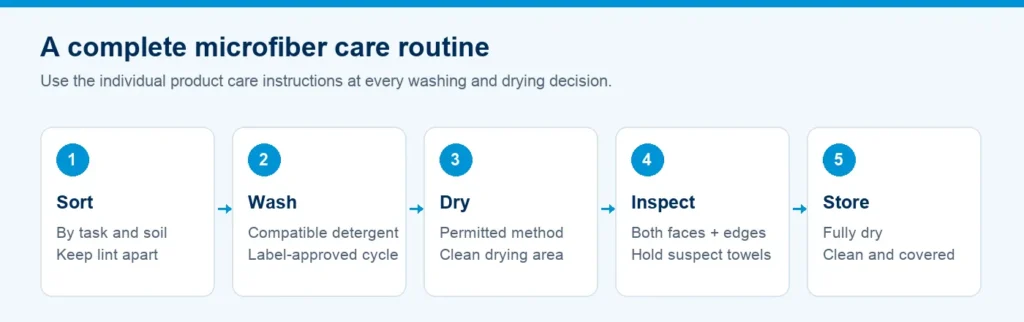
A clean towel workflow continues after the washing machine stops.
1. Sort Towels Before They Enter the Machine
Keep microfiber separate from cotton laundry and other items that can shed lint. Separate colors where dye transfer is a concern. For detailing work, also sort by use: paint finishing towels, glass cloths and towels from heavily soiled areas should not automatically share a load.
Check pockets, baskets and the machine drum for foreign objects. Unfold towels so hidden debris and folded-in residue are easier to spot. Do not mix a towel carrying visible grit into a load of finishing cloths simply because both products are microfiber.
Create separate collection points in a workshop. Labels such as “glass,” “paint” and “dirty-area towels” are useful even when you also use colors. A labeled basket is easier to interpret than a color system known only to one employee.
2. Inspect Contamination Before Deciding How to Clean
Examine both sides, edges and corners. Remove loose debris only using a method that does not drive it further into the fibers. If hard particles remain trapped, keep that towel away from paintwork.
Identify what the towel has picked up. Water from a final drying step presents a different cleaning problem from heavy polish residue or a product that cures after application. Follow the chemical manufacturer’s handling and cleaning instructions; ordinary laundering may not restore every contaminated towel.
Do not assume a long soak or a stronger chemical mixture will solve the problem. If the residue cannot be removed reliably, retire the towel from sensitive work. A low replacement cost does not justify uncertainty at the surface.
3. Choose Detergent and Dosage Carefully
Use a detergent compatible with the towel’s instructions and the washing machine. Check whether the machine requires a high-efficiency formulation, and follow the detergent’s dosage guidance for load size, soil level and water conditions.
A microfiber-specific detergent may be convenient, but its name does not remove the need to read directions. Avoid adding fabric softener or dryer sheets to the process.
Measure rather than pouring by habit. If towels repeatedly emerge with a slick feel, strong residual fragrance or visible foam during rinsing, review detergent choice and dosage. These observations are reasons to investigate; they do not identify a single cause on their own.
4. Set a Suitable Wash and Rinse Cycle
Choose the temperature and cycle permitted by the product instructions. A generic instruction to “wash microfiber hot” or “always wash cold” leaves out differences between products. If the load includes towels with different limits, do not exceed the most restrictive applicable instructions; separate the load when necessary.
Leave enough room for the machine to move and rinse the towels properly. Avoid forcing a large bundle into the drum just to finish the laundry in one load. Follow the machine’s capacity guidance and assess bulky towels accordingly.
After washing, check for remaining residue. An additional rinse may be useful when permitted, but repeated rinsing should not substitute for correcting an unsuitable detergent dose. If a towel still looks contaminated, keep it out of the clean stock while you decide whether further cleaning is appropriate.
5. Dry According to the Towel’s Limits
Air drying and tumble drying are options only where the product’s care instructions allow them. If tumble drying is permitted, use the approved setting; low or no heat is a common manufacturer recommendation, but the individual towel’s limit remains the reference.
Check the dryer drum and clean the lint filter according to the appliance instructions. Keep towels away from lint-shedding laundry and do not add dryer sheets. Remove the towels when dry rather than extending the cycle unnecessarily.
For air drying, use a clean rack in a ventilated area and separate the towels enough for air to circulate. Avoid locations exposed to dust, sanding debris or outdoor contamination.
6. Inspect Before Folding
A towel can look clean at a glance and still contain a problem in one corner. Open it fully under good lighting and check both faces, seams and edges. Look for embedded particles, hard residue, damaged sections or changes that make it unsuitable for its assigned task.
Do not use a vehicle’s paintwork as the test surface for a questionable towel. If its condition is uncertain, remove it from the paint towel supply. Assigning a towel to another job is appropriate only when it is clean and suitable for that new use.
For teams, make the inspection decision visible. Use a separate container for towels awaiting review so they cannot accidentally return to the clean shelf.
7. Store Clean Towels Where They Stay Clean
Fold towels with clean hands on a clean surface. Store them fully dry in a clean covered container or cabinet, separated by assigned use. Keep them away from open chemicals, dusty equipment and dirty collection baskets.
Do not compress a damp towel into sealed storage. If towels are not dry, finish the permitted drying process first. Wash or clean the storage containers as needed so the next load does not pick up debris from the previous one.
For mobile detailers, separate clean stock, used towels and towels needing inspection during transport. A tidy shelf at the workshop will not help if everything is mixed in one bag on the road.
Build Care Into a Branded Towel Range
If you buy microfiber detailing towels for resale, request product-specific care information before approving packaging. A useful care card explains washing restrictions, drying limits and storage without promising a fixed service life.
For private label microfiber towels, keep those instructions aligned across the sleeve, website and customer support materials. The OEM, ODM and private label buyer’s guide covers the approval questions to include in a brief.
Frequently Asked Questions
Should New Microfiber Towels Be Washed First?
Check the supplier’s first-use directions. Where washing is recommended, prepare new towels separately before mixing them into established stock, particularly when checking for dye transfer or loose lint.
Can Microfiber Towels Go in the Dryer?
Only if the care instructions permit it, using the allowed setting. Do not assume every microfiber product has the same heat tolerance.
How Many Washes Should a Towel Last?
There is no universal number. Construction, use, contamination and care affect serviceability. Inspect condition and performance rather than relying on a fixed retirement date.
What if a Drying Towel Stops Picking Up Water Well?
Review the care routine and check for residue or damage. Follow supplier guidance for any recovery attempt. If cleaning does not restore suitable performance, replace it. When choosing a replacement, compare the construction and handling as described in our microfiber towel selection guide.