
To choose microfiber towels for car detailing, start with the task, then compare the weave, weight, fiber blend, edges and size. Finally, evaluate samples under the conditions in which customers will actually use them. A high GSM or a soft first impression cannot answer every purchasing question.
For distributors and car care brands, the aim is a clear range: each towel has a useful purpose, an understandable specification and care instructions that support repeat use. This guide explains what to compare before placing a bulk order.
Start With the Detailing Task
Write down what the towel needs to do. Drying a freshly washed vehicle, wiping interior trim, cleaning glass and removing polish residue are different jobs. Treating them as one requirement makes sample comparisons confusing.
A useful starting range might include a drying towel, a glass cloth and a general detailing towel. Add specialist products only when you can explain the additional benefit to your customer. Keep towels used on wheels or heavily soiled areas separate from those intended for paintwork.
Choose a primary task for each proposed SKU. For example, “final wipe after polishing on a clean panel” gives a supplier more direction than “premium blue towel.” Include the surface, cleaning product and preferred handling method in the brief.
Compare the Weave and Pile
Weave describes the towel’s construction; pile describes the raised fibers on its surface. Both affect how the cloth feels and behaves. Supplier names can vary, so request close photographs and physical samples rather than relying on a construction name alone.
The following matrix is a starting point for sampling, not a guarantee that every towel in a category will perform identically.
| Construction | Common sampling application | What to check in a sample |
|---|---|---|
| Short-pile terry | General wiping and residue removal | Control when folded; residue pickup |
| Plush or longer pile | Buffing and finishing | Lint, drag and access around details |
| Waffle weave | Glass cleaning or drying, depending on design | Streaking and handling when damp |
| Twisted loop | Vehicle drying | Water pickup, drag and ease of wringing if permitted |
| Smooth or tight weave | Glass and mirrors | Lint visibility under angled light |
Avoid selling a weave as suitable for every surface. The complete product, its cleanliness and the way it is used still matter. A towel that works well for one cleaning product may need a different technique with another.
Understand What GSM Tells You
GSM means grams per square meter: the mass of a given area of material. It helps describe fabric weight, but it does not directly certify softness, absorbency or suitability for paint.
For a simple comparison, imagine a 40 × 40 cm towel weighing 80 g. Its area is 0.16 square meters, giving an estimated finished-item value of 500 g/m². This is an illustrative calculation, not a MICROMILL product specification. Binding, labels, moisture and measurement methods can affect comparisons with a supplier’s nominal fabric GSM.
Ask whether quoted GSM refers to the fabric or a calculation from the finished towel. Compare samples of similar dimensions and construction. Also assess handling: a heavier towel may become cumbersome when wet, while a lighter cloth may be easier to fold for controlled wiping.
Check the Microfiber Blend Without Treating It as a Grade
Ratios such as 80/20 and 70/30 generally describe polyester and polyamide content. Confirm the order of the materials on the specification rather than assuming it. Autofiber’s explanation of microfiber blends provides background on these common ratios.
The ratio is one comparison point. It does not reveal the complete construction, finishing quality or performance of a particular towel. Two products with the same stated blend can still feel and handle differently.
For procurement, record the declared composition alongside the weave, dimensions and weight. If a supplier recommends changing the blend, ask what practical improvement you should look for in the sample and compare it under the same conditions.
Inspect Edges, Labels and Workmanship
Unfold the towel and inspect the entire perimeter. Look for uneven binding, hard sections, loose threads and labels that could interfere with the intended wiping surface. Check both faces and the corners.
“Edgeless” describes a construction choice; it does not make a towel scratch-proof. Trapped particles, unsuitable use or an unnoticed hard area can still create problems. Before any paint contact, inspect the cloth and follow the relevant vehicle finish and detailing product guidance.
Consider how customers will identify the towel after removing its packaging. A practical color system can help separate tasks, but color alone does not indicate performance. Explain the assigned use on the pack or care card.
Evaluate Size as Part of the Workflow
A larger towel may cover more area, yet it can also be harder to manage around mirrors, lower panels and tight spaces. Fold the sample as a customer would, then check whether it stays comfortable in the hand.
For workshop buyers, include storage and laundry handling in the review. For retail buyers, check whether the folded towel fits the proposed sleeve or carton without hiding its useful texture. A clear product name and task description often help customers more than another decorative claim.
If drying is a major category in your range, compare dedicated car drying towels separately from smaller wiping cloths.
Run a Repeatable Sample Comparison
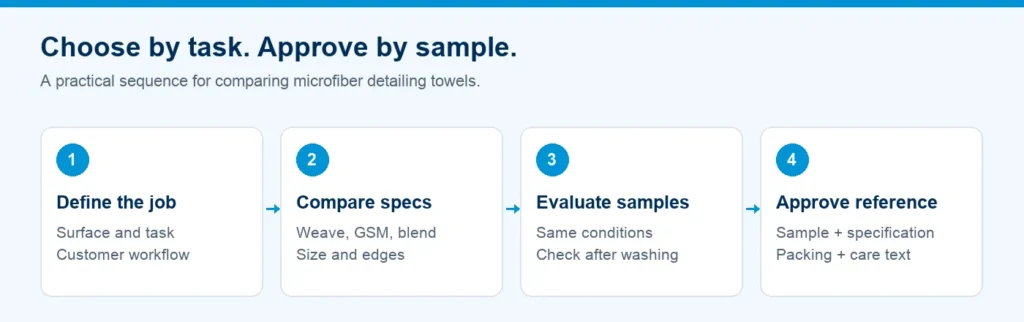
Use the same task and conditions when comparing candidate samples.
Create a short evaluation sheet before opening the samples. Record each sample’s code so impressions remain attached to the correct specification.
- Inspect the new towel. Photograph both sides, edges and labels. Record dimensions, stated construction and any visible defects.
- Prepare it as instructed. Follow the supplier’s first-use and washing directions. Keep comparison samples separate from contaminated laundry.
- Compare the intended job. Use equivalent clean surfaces, the same detailing product and a consistent method. For drying comparisons, control the starting water amount as closely as practical.
- Record observable results. Note visible lint, remaining streaks, ease of folding and user effort. Distinguish observations from unmeasured claims about capacity or durability.
- Repeat after laundering. Follow each product’s care instructions and check for changes in dimensions, texture and handling.
These are suggested comparison steps, not reported test results. If you intend to advertise numerical performance, arrange a suitable documented test rather than turning a casual demonstration into a product claim.
Turn the Chosen Sample Into an Order Specification
Keep an approved reference sample and attach a written specification to the order. Include the product code, dimensions, agreed tolerances, composition, construction, color reference, edge finish, pack quantity and care information.
Confirm how production differences will be checked and who approves substitutions. For branded ranges, review the label and packaging sample together with the towel. The OEM, ODM and private label buyer’s guide explains how to prepare that wider brief.
Frequently Asked Questions
Is higher GSM always better?
No. Select fabric weight alongside the intended task, construction, size and sample performance. A higher number alone is not a purchasing specification.
Can one microfiber towel handle every detailing task?
A general cloth can cover several jobs, but a range with clearly assigned drying, glass and wiping products is easier to explain and manage. Keep dirty-area towels separate.
Should care instructions influence the buying decision?
Yes. Check whether the recommended washing, drying and storage routine fits your customer’s operation. Our guide to washing and drying microfiber towels explains the questions to resolve.
Build a Towel Range With a Clear Purpose
Explore MICROMILL’s microfiber detailing towels and shortlist samples by application. Share your intended tasks, preferred sizes, packaging format and estimated order quantities when discussing a range. A specific brief makes the next quotation and sample review more useful.